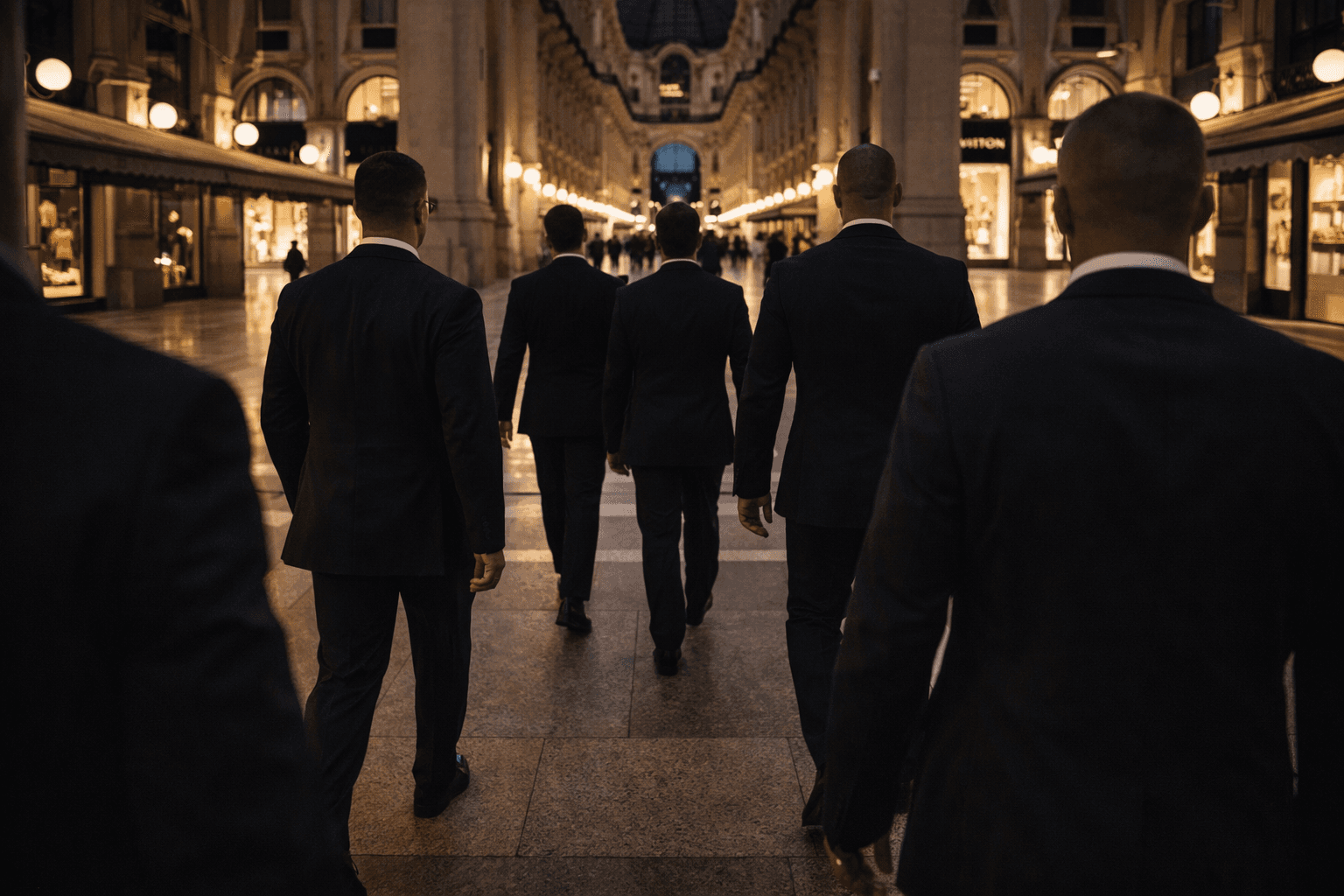
Paris is simultaneously one of the most surveilled capitals in the world (the Préfecture de Police de Paris manages 16,000+ CCTV cameras in the city, and the DGSI, Direction Générale de la Sécurité Intérieure, maintains one of the most capable counter-terrorism operations in Europe) and one of the most complex security environments for high-profile visitors. The concentration of UHNW individuals at Paris Fashion Week, the art fairs, the palace hotels, and the financial district creates specific threat profiles that require professional close protection protocols. FFGR operates a dedicated secure transport service for principals requiring executive protection: staffed by former members of the GIGN (Groupe d'Intervention de la Gendarmerie Nationale: the French counter-terrorism unit), the RAID (Research, Assistance, Intervention, Deterrence: the French National Police special operations unit), and the 2nd REP (Légion Étrangère parachute regiment). All information regarding client security arrangements is strictly confidential.
The Paris security environment: threat assessment
Paris presents a specific security environment that differs from London, New York, or Dubai in several significant ways :
**The terrorism threat:** France has experienced the highest incidence of terrorist attacks of any Western European country in the period 2015-2023, the November 2015 Paris attacks (130 killed, 413 injured, the deadliest attacks in France since World War II), the July 2016 Nice attack (86 killed), and a sustained series of smaller incidents (the 2020 beheading of Samuel Paty, the 2023 knife attack in Arras). The French national terrorism threat level (as managed by SGDSN, the Secrétariat Général de la Défense et de la Sécurité Nationale) has been maintained at "Urgence Attentat" (the highest level) continuously since November 2015. For UHNW principals visiting Paris, this threat environment requires awareness of high-profile public areas (the major tourist sites, the major commercial streets) and the capacity for rapid route deviation.
**The kidnapping and extortion risk:** Paris has one of the highest rates of express kidnapping targeting UHNW individuals in Western Europe, particularly in the western arrondissements (8th, 16th, 17th) where the concentration of wealth is highest. The principal threat comes from organised criminal networks operating from the banlieues who monitor the movements of wealthy individuals from Paris airports (CDG and Orly), palace hotels, and luxury retail addresses. The standard counter-kidnapping protocol requires surveillance detection (SD) routes, varying transport patterns, and avoiding predictable movements.
**The protest and civil disruption environment:** France has a political culture of public demonstration that periodically generates significant civil disruption in central Paris, the Gilets Jaunes (Yellow Vests) protests of 2018-2019, the pension reform protests of 2023, and the recurring climate and labour demonstrations create both physical impediments to movement (blocked streets, teargas) and security vulnerabilities (crowd concealment for opportunistic theft and assault). FFGR drivers maintain real-time liaison with the Prefecture of Police's daily protest and event schedule to route around disrupted areas.
The FFGR armoured vehicle fleet
FFGR's secure transport service operates the following armoured and security-configured vehicles :
**Mercedes-Benz S 580 L Guard (BR7):** the standard vehicle for UHNW principal transport, armoured to VPAM BRV 2009 Level 7 (ballistic protection against rifle fire, including 7.62mm armour-piercing rounds at 10 metres; blast protection against DM51 grenades detonated under the vehicle; glass protection against sustained fire). The S 580 Guard maintains the visual signature of a standard luxury sedan, the armour and protection systems are invisible from outside the vehicle. The fuel tank is self-sealing. Emergency door opening is possible from inside even under vehicle deformation. Maximum all-up weight: 5,800 kg.
**Range Rover Sentinel (VPAM 9):** the highest-level protection available in a commercial SUV platform, armoured to VPAM 9 (protection against 7.62x51mm NATO ball ammunition at 10 metres; blast protection against 15kg TNT at 2 metres; protection against hand grenades detonating under the vehicle). Preferred for principal transport in environments where route prediction is uncertain or where rapid off-road deviation may be required.
**Vehicle configuration:** all FFGR security vehicles are equipped with: run-flat tyre inserts (capable of sustaining controlled movement at 80 km/h for 80 km after tyre deflation), emergency communication system (encrypted satellite communication independent of cellular networks), first aid kit (trauma-level: tourniquets, haemostatic agents, emergency airway), fire suppression system, and emergency escape tool (glass hammer and belt cutter).
**The two-vehicle protocol:** for principals requiring the highest protection level, FFGR provides the two-vehicle protocol, a primary vehicle carrying the principal and a follow vehicle (the close protection advance car) carrying the CP team. The follow vehicle maintains 3-5 car lengths behind the principal vehicle in normal conditions and can respond to a vehicle stop or barrier in under 8 seconds.
The FFGR close protection team
FFGR's close protection personnel are recruited exclusively from the following backgrounds :
**GIGN (Groupe d'Intervention de la Gendarmerie Nationale):** the French counter-terrorism and hostage rescue unit, one of the most elite law enforcement units in the world, created in 1974 following the Munich massacre, with a documented success rate in hostage rescue operations of over 95%. GIGN operators complete 14 months of initial training (including over 11,000 rounds of live-fire training in the first year, parachute qualification, combat diving, and medical first response) before joining operational squadrons. Former GIGN operators working with FFGR are all post-operational (minimum 10 years service, multiple operational deployments) and hold current CNAPS (Conseil National des Activités Privées de Sécurité) close protection licences.
**RAID (Recherche, Assistance, Intervention, Dissuasion):** the French National Police's special operations unit, the police-equivalent of the GIGN, created in 1985. RAID operators have participated in the response to every major terrorist incident in France since 1985 and are considered to have the most experience of urban close-quarters combat in the French security services.
**Communication protocols:** FFGR close protection teams operate with encrypted digital radio communication (Motorola DP4801 encrypted, AES 256-bit) and maintain real-time liaison with the Préfecture de Police de Paris intelligence unit (DRPP, Direction du Renseignement de la Préfecture de Paris) for advance intelligence on demonstrations, criminal activity alerts, and VIP movement coordination.
**All security arrangements are strictly confidential.** FFGR does not publish information about the identity of clients under protection or the security protocols applied to specific assignments. This section describes the capability; the specific application to any individual client is discussed exclusively in secure pre-mission briefings.
The advance security assessment
All FFGR secure transport assignments above the standard executive transport level include an advance security assessment :
**Route analysis:** for each assignment, the FFGR security team conducts a route analysis 24 hours in advance, identifying: choke points (locations where the vehicle cannot deviate from the route, such as tunnels, one-way streets, or bridges), standing vehicle risk areas (locations where the principal's vehicle may be stationary for more than 30 seconds, hotel entrances, restaurant drop-offs, traffic lights), and emergency vehicle access points (the nearest trauma hospital to each stop on the route, the Hôtel-Dieu (Île de la Cité), the Lariboisière (18th, the closest trauma centre to CDG), and the Hôpital Américain (Neuilly, the preferred facility for UHNW international clients).
**Venue assessment:** for each destination on the principal's itinerary, the FFGR advance team conducts a venue assessment, identifying secondary entrances (avoiding the main entrance where visibility to hostile observation is maximised), internal routing to the meeting location, emergency exits, and the security staff at the venue (coordination with hotel security at palace hotels, the Préfecture de Police escort at government buildings, and the private security of corporate headquarters).
**Countersurveillance:** for high-risk assignments, the FFGR security team can deploy a countersurveillance element, a separate operator following the principal's route at a distance of 200-500 metres to identify surveillance vehicles or individuals following the principal's movements. This is standard protocol for principals whose movements may attract criminal or hostile intelligence interest.
The Paris palace hotel security circuit
The major Paris palace hotels (Le Bristol, The Ritz, the Four Seasons George V, the Hôtel de Crillon, the Plaza Athénée, the Shangri-La, Le Meurice) each have established protocols for UHNW client security :
**Hotel arrival protocol:** FFGR armoured vehicles are cleared for the private vehicle court of each palace hotel, avoiding the main entrance where public observation is maximised. The hotel security teams (former police and GSPR, Groupe de Sécurité de la Présidence de la République, operators at the top hotels) coordinate with FFGR drivers for arrival and departure timing, maintaining the principal's departure from the hotel as a controlled event.
**The Ritz Place Vendôme:** the Ritz has an additional access via the Rue Cambon entrance (parallel to the Place Vendôme) which provides a discreet secondary arrival point, used historically for classified guests including Coco Chanel (who lived in the hotel from 1937 to 1971). FFGR vehicles can access the Rue Cambon entrance for clients requiring enhanced discretion.
**The Bristol Faubourg Saint-Honoré:** the Bristol's location on the Rue du Faubourg Saint-Honoré (adjacent to the Élysée Palace, which is permanently protected by the Republican Guard and the GSPR) means that the immediate area around the hotel is one of the most surveilled and protected zones in Paris, the proximity to the Élysée provides a natural security buffer that benefits hotel guests.
Booking secure transport and executive protection
FFGR's secure transport service operates on a different booking protocol from standard luxury transport :
**Initial consultation:** all secure transport assignments begin with a confidential consultation with the FFGR security coordinator, typically by encrypted message or secure voice call. The consultation covers: the nature and duration of the assignment, the principal's known threat profile (if any specific risk factors are identified by the client's own security team), the principal's movement itinerary, and the integration with any existing close protection resources the client may have (personal bodyguards, corporate security teams, national protective services).
**Security clearance:** FFGR close protection operators hold the French CNAPS professional security licence (Carte Professionnelle, issued by the CNAPS on verification of training, background check, and medical fitness). All operators are subject to the French national security service background check (habilitation de sécurité, required for operators working in proximity to protected persons).
**Advance booking:** secure transport assignments should be booked with a minimum of 48 hours advance notice to allow the route analysis, venue assessment, and team briefing to be completed. For assignments requiring countersurveillance or a two-vehicle protocol, 72 hours advance is preferred. Emergency secure transport (airport collection under security protocol, urgent principal relocation) can be arranged with 4-6 hours notice subject to availability.
Contact us at reservation@ffgrparis.com or WhatsApp +33 7 43 46 14 91. For security-sensitive enquiries, please specify your preferred secure communication method.
Бронирование
FFGR's executive protection and secure transport service, with armoured S-Class and Range Rover Sentinel vehicles, CP-trained drivers from the GIGN and RAID, advance route security assessment, and integration with Paris palace hotel security protocols, provides the highest level of discreet secure transport available in Paris. All arrangements are strictly confidential. Contact us: reservation@ffgrparis.com · WhatsApp +33 7 43 46 14 91.
ЗабронироватьПохожие статьи
 security
Paris Diplomatic Transport | Chauffeur & Protocol Ground Services for Embassies
How FFGR Paris provides diplomatic and protocol ground transport: embassy transfers in the 7th and 16th arrondissements, ministerial and heads-of-state visits, official function ground coordination, armoured vehicle options, and the protocol standards that French diplomatic transport demands.
9 min
 security
Paris Diplomatic Quarter Chauffeur | UNESCO, Embassies and the 7th Arrondissement Circuit
Ground transport for Paris diplomatic and institutional appointments: the UNESCO headquarters at Place de Fontenoy, the embassy circuit in the 7th and 8th arrondissements, the OECD at the Château de la Muette, and the specific vehicle management protocols for addresses under permanent security surveillance.
9 min
securityParis Institutional Circuit Chauffeur | Élysée Palace, Matignon, National Assembly and the Political Transport Protocol
Ground transport for the Paris political and institutional circuit: the Élysée Palace (Rue du Faubourg Saint-Honoré), the Hôtel Matignon (Rue de Varenne), the Palais Bourbon (Quai d'Orsay), the Sénat at the Palais du Luxembourg, the Quai d'Orsay (Ministère des Affaires Étrangères), and FFGR's approach to protocol-compliant transport for diplomatic delegations, heads of state, government counterparts, and international organisations visiting the French capital's institutional complex.
10 min